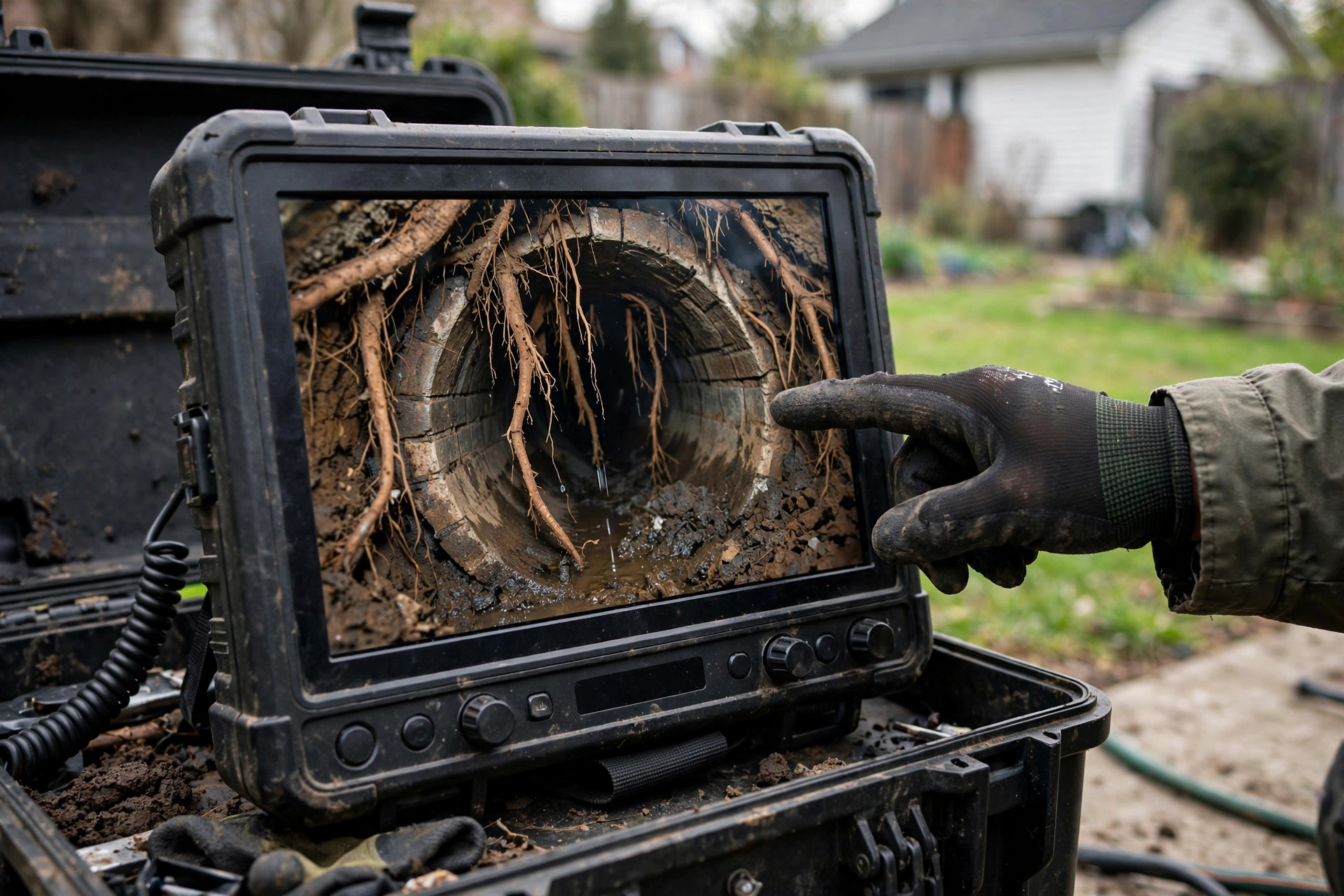
Tree roots don't break into sewer lines — they walk through open doors. Every joint in an older lateral is a tiny gap, and roots sense the moisture and nutrients inside. Once a root finds its way in, it grows into a fibrous mass that catches everything flowing past, and the line that used to drain fine starts backing up on a schedule.
We cut roots out mechanically with specialized root-cutting heads, then hydro jet the line to scour out what's left. The camera shows us exactly where the intrusion is and how bad it is — a few tendrils at one joint is a different situation from a root mass at every joint, and the long-term answer depends on which one you're looking at. For isolated intrusion, cutting plus a spot repair or lining at that joint ends it. For a line that's root-bound along its length, we'll tell you honestly that cutting is maintenance, not a cure.
If your Greenville drains back up every few months and there's a big tree anywhere near the sewer path, call (555) 123-4567. It's probably roots.
Signs roots are in your sewer line
- Backups or slow drains that return on a regular schedule
- Gurgling drains, especially after heavy water use
- A large tree growing near the sewer line's path
- Camera previously showed roots (and they were only cut, not fixed)
- One fixture backs up while others still drain
How we remove roots
1 Camera first
We find exactly where the roots are and how extensive the intrusion is. Cutting blind wastes time; the camera tells us which joints are breached and whether the pipe itself is still sound.
2 Cut the intrusion
Root-cutting heads shear the mass out of the pipe mechanically. This restores flow — but it's worth knowing that cutting alone doesn't close the entry point.
3 Jet the line clean
Hydro jetting scours the remaining root fibers and buildup off the pipe walls, restoring the full diameter. A cut-but-dirty line reclogs faster.
4 Fix the entry point
We show you the camera footage and explain the long-term options honestly: a spot repair or lining at breached joints ends the cycle; repeated cutting manages it. You decide with full information.
Roots and Greenville's older lines
Greenville's established neighborhoods are prime root-intrusion territory: mature oaks and pecans with aggressive root systems growing over original laterals full of joints. The big shade trees that make those streets beautiful are the same ones finding every mortar joint in a clay lateral — and the Blackland clay's movement keeps opening those joints wider. We see the pattern constantly — a home with a thirty-year-old oak in the front yard and a sewer line of the same vintage is almost guaranteed to have root intrusion at some point. Cutting buys time; fixing the breached joints buys the line. The camera footage tells us which one your situation calls for.
Need sewer root removal in Greenville?
No forms, no waiting — one call connects you with a local technician.
(555) 123-4567 📞 Call Now